Thursday, July 22, 2010

Zuchinni Garden Pepper Relish

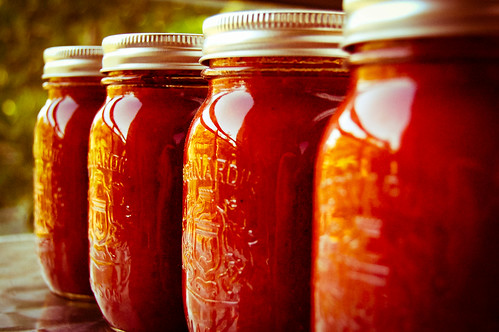
Zucchini Garden Pepper Relish

I knew exactly what I was going to make when zucchini season came around. A few years back a friend was gifted a few jars preserves and one of them was a zucchini relish. I've never been a fan of the nasty green stuff served at a BBQs, but this zucchini relish was nothing like that and I loved it. I really wanted to make my own batch and since this month's Can Jam theme was "cucurbits", the timing was right.

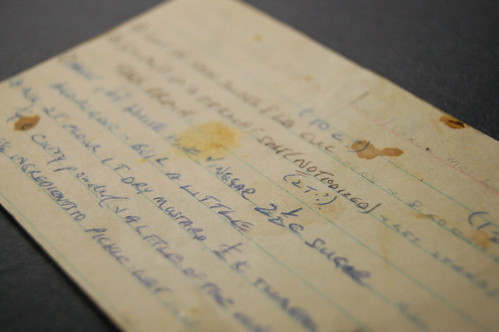
My wife joined me, helping out with all the prep work. Everything was ready to go in the pot, and as soon as all the ingredients started to warm up on the stove, my wife commented on how great everything smelled. She kept saying how much it reminded her of something, and how familiar it was. With a light bulb moment she ran over to her mother's recipe box that is crammed with old recipes for family favourites and newspaper clippings from years ago. She shuffled through the cards and found a section with all of her mother's preserves, and plucked out a card with recipe for "Mild Mustard Pickle Relish".

The card itself had a history of its own, a bit dog eared, a bit of food spatters and some scribbled notes in the corners. Now what I found amazing about all this, was how the smell triggered such a vivid memory for my wife. The scene was painted lovingly of her mother making this relish while she helped as a young girl. I loved how all of this was preserved. How a simple act of cooking brought out a far memory. It was pin pointed to that recipe card in a matter of seconds.

The recipe I chose seems to be pretty generic as a few of my books' versions were very similar. I wanted to add a dimension of heat so I added some Jalapeno peppers and some ancho chile powder. We tried this one immediately and loved it. It was fabulous with some pork chops we had that evening. I'm sure it will be fantastic at a family BBQ in few weeks were we can enjoy and recall the fond memories it stirred up of my wife's Mom.

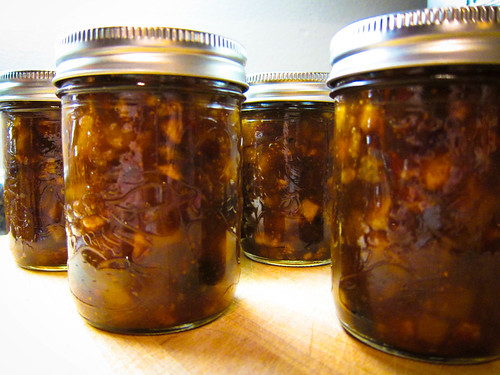
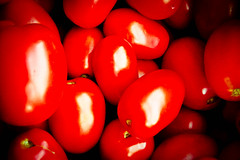
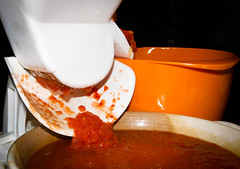
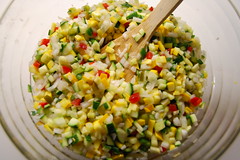
Zucchini Garden Pepper Relish Zucchini Garden Pepper Relish Zucchini Garden Pepper Relish

Zucchini Garden Pepper Relish
(adapted from the Complete Book of Small-Batch Preserving)

Ingredients:
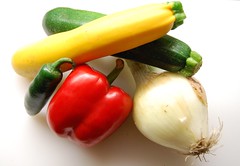
4 Medium Zucchini finely chopped (about 1 1/4lbs)
2 Medium Onions finely chopped
1/2 Sweet Red Pepper finely chopped
1/2 Sweet Green Pepper finely chopped
2 Jalapeno Peppers finely chopped (optional)
2 tbsp Pickling Salt
1 1/4 cups Granulated Sugar
3/4 cup Cider Vinegar
1 tsp Dry Mustard
1 tsp Celery Seeds
1 tsp Ancho Chile Powder (optional)
1/2 tsp Tumeric
2 tsp Cornstarch

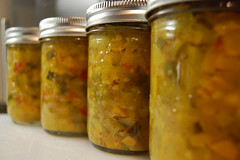
This recipe yielded 4 - 500ml Jars

1 - Toss together zucchini, onions and peppers in a large non-reactive bowl. Sprinkle with the salt and stir well. Let stand for 1 hour, stirring occasionally.

2 - Drain vegetables in a sieve and rinse, then drain again, pressing out excess moisture.

3 - Combine drained vegetables, sugar, vinegar, mustard, celery seeds, ancho chile powder and tumeric in a large stainless steel or enamel saucepan. Bring to a boil over high heat, reduce the heat and continue boiling gently, uncovered for 15 minutes or until vegetables are tender.

4 - Blend water and cornstarch, stir into vegetables. Cook for 5 minutes or until the liquid thickens, stirring often.

5 - Remove hot jars from canner and ladle relish into jars to within 1/2 inch of the rim. Process jars for 10 mins.

Friday, June 25, 2010

Cerejas com Aguardente

Cerejas com Aguardente

With the World Cup on and my team about the hit the pitch against Brazil in a few minutes I wanted to give this month's preserves a little Portuguese nod. I wanted to make something that we could use as a dessert topping and in a cocktail. As the summer heats up I will be pulling out our Ice Cream maker and one of these will be the final topping on a tasty homemade sundae. I'm also really looking forward to using one of these in a Manhattan instead of one of those nasty nuclear red jarred supermarket Maraschino cherries.

Where I adapted this recipe was in the alcohol I used. Aguardente is popular Portuguese brandy that is made by using the spent grape must after wine making, very similar to an Italian grappa. I also added a touch of Amaretto to add an hint of almond flavor.

Cerejas com Aguardente
(adapted from the Bernardin Complete Book of Home Preserving)

Ingredients:
approx 4 cups of Cherries
2 cups of Water
1 cup of Sugar
1 tbsp of Aguardente
1 tsp of Amaretto

This recipe yielded 2 - 500ml Jars

1 - In a saucepan, over medium heat combine sugar and water. Bring to a boil, stirring to dissolve sugar. Add the cherries, stirring constantly, and return to a boil. Reduce heat and boil gently for 5 minutes.

2 - Using a slotted spoon, pack cherries into prepared hot jars to within about 1/2" of top of jar and add the Aguardente and Amaretto. Ladle hot syrup into the jars to cover the cherries leaving 1/2" of headspace. Remove any air bubbles, adding more syrup if needed. Seal with prepared lids and hot water process for 15 minutes.

Thursday, May 20, 2010

Pickled Asparagus


I think this month there will be lots and lots of pickled asparagus. I knew the minute that this months theme was announced that it was my first choice. The other ingredient that shared this months theme spotlight was rhubarb, and I am not a fan. I've never enjoyed it, last year's strawberry/rhubarb jam and rhubarb chutney sit ignored on our storage shelf and I always side step them for other favorite preserves.

I've read about using the asparagus as garnish in a Ceaser... mmm that sounded tasty, so here is the recipe that I used, not much was adapted although there was an error in my printed copy as the sugar was missing from the ingredient list. I made one jar with the chili and 2 without so I had a variation. Can't wait to try these in a few weeks.

Pickled Asparagus
(adapted from Well Preserved by Mary Anne Dragen)

Ingredients:
approx 5lbs of Asparagus
4 cups of Water
4 cups of White Vinegar
1 large Onion peeled, halved and sliced in 1/4" slices
6 cloves of Garlic
3 tbsp of Pickling Salt
3 tbsp of Sugar
3 tbsp of Mustard Seeds
2 tbsp of Dill Seeds
Chili Peppers (optional - I used 2 small Serrano's in 1 jar)

This recipe yielded 3 - 1L Jars

1 -Trim Asparagus spears to jar length - I used a great tip from Well Preserved here! They should stand at least 1" shorter than the rim of the jar.

2 - Perpare your canning jars and lids

3 - Combine water and vinegar in a pot and bring to a boil. Reduce the heat and keep the mixture at a simmer.

4 - Working with 1 jar at a time, place a third of the onion slices, 2 cloves of garlic, a chili pepper if using, 1 tablespoon each of sugar, salt, mustard seeds and 2 teaspoons of dill seed. Pack the asparagus in each jar tips down. It helps to lay the jar on it's side - I really wish I had used a wide mouth jar for these. It would have prevented damage to the spears and made loading the jars much easier! Pack them in tight.

5 - Pour hot vinegar liquid into the jars leaving 1/4" headroom and seal with prepared lids. Hot water process jars for 20 minutes.

Saturday, April 24, 2010

Lemon Sage & White Wine Mustard

Lemon Sage & White Wine Mustard

I wasn't sure what I could make for this months Can-Jam Herb theme, I was a little stumped. The only thing that kept coming to mind was mint jelly... and I'm not exactly a fan. So I remembered a post from last months Allium Can-Jam for a Garlic & Lemon mustard.. I loooove mustard, and have quite a few different jars on the go at one time, but I have never tried making my own, until now.

After flipping through my books I landed on a recipe that sounded like it would be a winner, Lemon, Sage and white wine. The only adaptation I made was replacing a 1/4 cup of the yellow mustard seeds with brown, simple reason... I was short on yellow mustard seeds and had a bunch of brown seeds on hand.

Lemon Sage & White Wine Mustard
(adapted from The Complete Book of Home Preserving)

Ingredients:
1 bunch of fresh sage
3/4 cup of Dry White Wine (I used a Chardonnay)
1/2 cup of Yellow Mustard Seeds
1/2 cup of Brown Mustard Seeds
1 cup of White Wine Vinegar (must have at least 5% acidity)
Grated Zest & Juice of 2 Large Lemons
1/2 cup of Honey
1/4 tsp Salt

This recipe yielded 5 - 125ml Jars

1 - Finely chop enough sage leaves to measure 1/3 of a cup and set aside.

2 - Coarsely chop remaining sage leaves and stems to measure 1/2 cup and place in a stainless steel saucepan with the wine. Bring to a boil over medium heat, stirring and pressing the leaves to release their flavours. Remove from heat, cover and let it steep for 5 minutes.

3 - Transfer sage infusion to sieve placed over a glass or stainless steel bowl and press the leaves with the back of a spoon to extract all the liquid. Discard the solids and return the liquid to the saucepan. Add the mustard seeds . Cover and let them stand at room temperature until the seeds have absorbed most of the liquid, about 2 hours.

4 - Prepare canner, jars and lids.

5 - In a blender (or food processor fitted with a metal blade), combine the marinated seeds and liquid with vinegar. Process until blended and most seeds are well chopped, I kept a slightly grainy texture.

6 - Transfer mixture back to the saucepan and add lemon zest, lemon juice, honey, salt and reserved chopped sage. Bring to a boil over high head, stirring constantly. Reduce heat to low and boil gently, stirring frequently, until volume has reduced by a third, about 20 minutes.

7 - Ladle hot mustard into hot jars, leaving 1/4 inch of headspace. Process jars for 10 minutes.

Monday, March 15, 2010

Carmelized Red Onion Relish

DSC_0118

This month started with another low acid warning! Much like the warning we received for last months theme, the carrot, we were given another ingredient to can that was low on the acid meter, the Allium family. I chose to adapt another recipe from a published source to make sure that I was keeping the acidity at a proper level.

My first thought was some sort of Balsamic Onion Confit. I sampled one a while back that was an excellent pairing with a foie gras tourchon and loved its sweet and sour tang. I hit the few books I had and found a quick and small batch recipe for a Caramalized Red Onion Relish. The ingredient list was short and to the point and looked to contain everything I needed to make something that resembled that confit. I changed up the basic red wine called for in the recipe for some Commandaria, a desert wine from Cyprus that is similar to a Tawny Port. I figured it would give the balsamic a boost and add another dimension to the flavour.

I'm really happy with the end result. A soon as I sampled a taste I immediately thought of running out to get some crusty bread and some sharp aged cheddar for my take on a ploughman's lunch.

DSC_0126 DSC_0102

Carmelized Red Onion Relish with Commandaria
(adapted from The Complete Book of Small-Batch Preserving by Ellie Topp and Margaret Howard)

2 large red onions, peeled and chopped
1/4 cup firmly packed brown sugar
1 cup of Commandaria Wine (or dry red wine)
1/4 cup of balsamic vinegar
1/8 tsp each of salt and freshly ground pepper

This recipe yielded 4 - 250ml Jars 

Combine onions and brown sugar in a heavy non-stick skillet. Cook uncovered over medium-high heat for 25 minutes or until onions turn golden and start to caramelize, stirring frequently.

Stir in wine and vinegar. Bring to a boil over high heat, reduce heat to low and cook for about 15 minutes or until most of the liquid evaporated, stirring frequently.

Season to taste with salt and pepper.

Remove hot jars from canner and spoon relish into jars to within 1/2 inch of rim and process for 10 minutes.

Thursday, February 18, 2010

Pickled Rosemary Carrots

DSC_0019

With all the warnings on the low acidity scariness that is the carrot this month, I decided to not stray too far from a published recipe found in Well Preserved by Mary Anne Dragen. I really wanted to have something on hand that would be a good accompaniment to have with some charcuterie. Haven't been able to try them yet, but I hope to report back good results in a few weeks.

DSC_1218 DSC_0001

Pickled Rosemary Carrots
(adapted from Well Preserved by Mary Anne Dragen)

Ingredients:
3 Cups of Water
3 Cups of White Wine Vinegar (must have at least 5% acidity)
1/4 Cup of Sugar
1/4 Cup of Pickling Salt
2 Tablespoons of Mixed Peppercorns
6 Cloves of Garlic
6 Hot Red Chili Peppers
4lb of Carrots - cut into sticks about 4 inches long
6 Sprigs of Rosemary

This recipe yielded 5 - 500ml Jars

Combine the water, vinegar, sugar, salt, and peppercorns and bring to a boil and simmer for 5 mins.

Take 1 hot sterilized jar at a time, add 1 garlic clove, 1 chili and 1 sprig of rosemary. Pack the carrot sticks tightly into the jars standing them upright. Pour the liquid in the jars and leave a 1/4" of head space and hot water process for 15mins.

Friday, January 22, 2010

Seville Orange Marmalade

Seville Orange Marmalade

My first attempt at marmalade was using a very non-traditional citrus ingredient, the Buddha's Hand Citron. But I still wanted to try making marmalade with the traditional Seville orange. Seville's have just recently started appearing at shops here in Toronto so I loaded up on and started out with trying 2 different recipes.

The first recipe I used was from a recent episode of Good Eats. I've always liked Alton Brown's show for his mix of science and cookery. For a contrast I used a recipe that an old neighbor of mine was glad to share. As a columnist at the Toronto Star he would publish his wife's recipe annually when Seville orange season rolled around.

What I wanted to see by trying out the 2 was how different would they be? Alton Brown's recipe can be made in a day, Ayesha's took 3...  Would Alton's scientific approach trump Ayesha's tried and true, year in year out version? Alton's was tasty, but I really did prefer Ayesha's in the end. I followed both to the letter but the texture of the peel in Alton's was still a bit to hard and bitter, I think it could have used a longer boil to soften it, or was it the lack of soaking time that Ayesha included in her process?

Seville Orange Marmalade

So now after all that Marmalade making I have over 20 jars completed. Looking at all the fantastic ideas that have started rolling in for the Tigress Can Jam, I'm now inspired to try something outside the marmalade realm. When I do decide to make seville orange marmalade again I will be going with Ayesha's recipe. Below is her recipe as it was given to me.

Ayesha's Seville Orange Marmalade

Ingredients:
8 Seville Oranges
8-12 cups of water (I used 10 cups)
6 cups of sugar

This recipe yeilded 8 - 250ml Jars

Look for fruit with soft, shiny skin, never mind the warts. Eight oranges will do first time out. Wash and dry the fruit.

Seville Orange Marmalade Seville Orange Marmalade

With a sharp knife, slice the whole oranges as finely as you can - skin, pith and pulp. But be careful not to cut the seeds or let them dry out - they contain the pectin and you'll need them.

You can either leave the seeds with the mixture to boil, skimming them off just before you bottle the marmalade, or put them in a cheesecloth bag, leaving them to boil until you remove them again just before bottling.

Put the sliced oranges into a large bowl, earthenware if possible, and for every orange you started with, add a cup or a cup-and-a-half of water, depending on how thick you want the marmalade to be. Cover the bowl with a cloth (not plastic wrap) and keep it for two or three days at room temperature, stirring occasionally.

Now the first boil: with a lid on, simmer the fruit in a large pan for an hour or two - until the peel feels soft when you squeeze it between your fingers (don't burn yourself!). Pour the fruit back into the large bowl to cool.

The secret of the second boil is not to do it all at once. Measure four cups of the fruit into the pan with three cups of sugar and boil rapidly for 15 or 20 minutes. When it starts to thicken, put a small amount in a dessert or tablespoon and put it in the fridge. If, after a few minutes, you detect a skin on the surface, it's ready.

Take the pan off the stove and let it cool for five minutes (while you remove the seeds) before putting the marmalade into sterilized jars and hot water process.

Seville Orange Marmalade